
Sa Benedica
Maria Christina Chizzoniti, niece of Frank Bucherati, digitized the Port Washington portion of her uncle’s memoirs for publication in this Journal.
“‘Sa Benedica” is a blessing, now often used as a greeting.
‘Sa Benedica
by Frank Bucherati
Part I
In 1911 father found a job laying and maintaining railroad tracks for a sand and gravel company in Port Washington, L.I. To save money he ate and slept in a small shack near the sand bank and came home on weekends. After a few months he rented a room with an Italian family in the “exville” section. When more rooms became available, he sent for us and we moved to Port Washington. In the next few pages, I will write about the Port Washington period which lasted until 1917.
We stayed in “exville” a very short time and moved to a house in the Beacon Hill section. It was one of several owned by a Mr. Bordon (His real name was Ferraro). He also owned a saloon at the end of the road and a large building adjoining it with a hall he rented for weddings and other social events. At the top of the hill was the house we moved into. It was a two family, two story building, four rooms in each house. When we first moved there, we shared the place with another family until they moved out.

The Francesco Bucherati family, Frank, second from right, next to his father
About this time father was made section leader at work and earned 25 cents a day more than the other workers. He was also able to get a job for Uncle Tony Scappatore, so Aunt Santina and Uncle Tony moved into the house next to us. To get to work father and uncle had to walk about three miles. Later they bought second-hand bicycles.
A Norwegian family lived in a house across the road from us. Mr. Edwards was a carpenter who was mechanically inclined. He had an old automobile he was always tinkering with. The Edwards had four children, Gerti, Eddy, Thelma and Lily. Their ages ran from about my sister’s to mine so we immediately had English speaking friends and playmates.
At the end of the curving road was a school yard and then the eight-room white schoolhouse where I started kindergarten.
Across the road from the school was another house owned by Mr. Borden. After a
few years when we needed more room, we moved into that house.
While living in the two family house mother gave birth to twins, Anthony and Michelangelo. Michelangelo died one week after birth. During this same period Aunt Santina gave birth to Joseph and Anna. In New York, but over a longer period, Aunt Santa Merendino gave birth to Josephine, Mary and Margaret. Aunt Filippa Amodeo gave birth to Vincent, and Aunt Concetta gave birth to Phillip, Anthony, Thomas, Stephen, Anna, Rose and Frank Paul.
Living in Port Washington was better than New York but it was still rugged. We had to use kerosene lamps for illumination, and as in New York, we had a wood-burning Franklin stove. There was cold running water in the house but for a toilet we had an outhouse. Every year or so father had to dig a new hole and move the outhouse.
To supply wood for the stove father bought old railroad ties. On Sundays father and Sal sawed the ties into short lengths and then chopped them. My job was to sit on the sawbuck while the ties were being sawed and then stack the wood up in the barn after it was chopped. There were two barns. In the second barn mother raised chickens, so we had chicken every Sunday and eggs almost every day.
My father and Uncle Tony both had vegetable gardens. Because of their early experience they had great success in growing almost everything. The chore of watering the garden fell on Sal and me. We had to fill buckets in the house and carry them out to the garden about 100 yards away.
Father was an expert at weaving baskets from willow twigs. The baskets were put to good use in many ways.
We had apple trees on our grounds. Father dug a deep hole in the sandy ground in back of the house and layers of apples were placed in the hole, each apple and each layer being covered with sand. In the winter whenever we wanted an apple all we had to do was dig it up. The apples were just as fresh as when they were first put there.
We had no refrigeration, not even an icebox. Vegetables from the garden were picked and eaten as needed but some were stored in the barn and in wicker baskets kept in the bedrooms. Mother and Aunt Santina used some tomatoes to make tomato paste.
In winter the rooms were uncomfortably cold. Walls were thin, there were no storm windows; no heat of any kind. We kept on our heavy underwear when we went to bed and when we woke up in the morning, we immediately rushed down to the kitchen to warm up near the wood-burning stove.
Anna, Sal and I went to the public school. I started in kindergarten when I was five. The school only went up to the sixth grade, so Anna had to go to the Port Washington High School on Main Street after one year.
Our school was at the top of a hill. Beyond it was a straight drop. There were some narrow steps down to the lower level road but they were not kept in repair, so they were rarely used. Most used the dirt road in front of our house. Opposite the school, on the same side of the road as our house was a large house with a fenced in lawn and yard. The house was empty except for a few months during the summer when two couples came there. They were probably schoolteachers but because they owned an automobile we called them the millionaires. At the beginning of the summer the younger of the two men came alone and leveled off the road to make it passable for their car.

Francesco, center, followed by Frank and his brothers, 1953
Between the millionaires’ and the last Borden house we lived in were several attached houses. All but one tenanted by families with several children, but the house next to ours was tenanted by Mr. and Mrs. Brown who were childless. On Sundays Mrs. Brown would send me to buy the Sunday New York American. She would give me five cents and also let me keep the funnies. That’s how I first became acquainted with the trials and tribulations of such comic strip characters as Polly and her Pals, Krazy Kat, Happy Hooligan, Jiggs, Mutt and Jeff, Buster Brown. Boob McNutt, Nemo and Hon and Dearie.
Although times were rough and money was scarce, we were a closely knit family and relatives often visited us Sundays, weekends and sometimes for weeks, especially during the summer. A favorite summer visitor was Aunt Santa Merendino. All the children would gather around to listen to her tell stories about the adventures of Giuva, a mischievous boy who was a combination of Tom Sawyer, Huckleberry Finn and the Katzenjammer Kids. She also told us stories about the Holy Family, the life of Christ and the Apostles. Although she could not read or write she knew every story in the New Testament. And the way in which she told the stories made us feel they were not just holy figures in remote past but village neighbors who talked the way we did. I knew all about the miracles and the parables in the New Testament long before I was able to read the Bible.
One summer day about twenty of the Merendino, Bono, and Bocchiaros from New York and Brooklyn came to visit us at one time. They brought all kinds of food with them; macaroni, cheese, bread, olives and sausages. The women started preparing the food. The men and boys went fishing in Manhasset Bay about a mile from our home. Several of the men dressed as sailors but their pants were actually long johns, and their shirts were girls’ middy blouses. For fishing they used colanders. For bait, pieces of bread were tied to the colanders. They waded into the bay, lowered the colanders into the water and instantly the colanders were filled with minnows. The colanders were quickly pulled up and the catch emptied into buckets.
They brought the minnows home where they were covered with egg and flour batter, fried and eaten while hot.
There were so many of us for the feast that they had to make some tables and benches and place them in the school yard. Some of the neighbors came and joined in the festivities. As usual there was singing and guitar and mandolin playing.
Part II
At Christmas we generally received winter underwear as gifts. However, the Edwards’ children received all sorts of games and toys, and we were invited to join them.
One year when mother had saved sufficient coupons from The Kirkman soaps, father went to New York and exchanged them for a set of building blocks. That gift was treasured by us for many years.
During the long winter nights, we listened to father tell us stories while we sat around the kitchen stove and roasted potatoes or cracked walnuts we ourselves had gathered.
Father told us stories about life in Italy and of the places and things he had seen while in the army. He described the wonders of the cathedrals of Palermo, St. Peter’s Cathedral in Rome, Michaelangelo’s statues of Moses and David, Leonardo da Vinci’s Last Supper and Raphael Santi’s Sistine Madonna. It was apparent that Father’s education had not stopped with the few years of formal schooling. As a matter of fact, he had earned money while in the army by teaching other soldiers to read and write. We were to benefit by this ability. One day he brought home a “Silabario” and spent hours teaching Sal and me to read. Since we spoke Italian at home we were soon able to read simple sentences. One difficulty we did have was that we spoke the Sicilian dialect which often differed from the written word.
Of all of father’s stories the ones that interested us most were the romantic tales of the Paladins of France. We could never hear enough about Carlo Magno and Orlando. Father was very dramatic and was a born storyteller. To satisfy our craving, one day father brought home a book about the size of the Manhattan telephone book. It was the romanticized history of the ancient Franks. For many a night father would read one or two chapters of the book to us. We would sit enthralled hearing about the battles and court intrigues. We became familiar with Charles Martel, Pepin, and Charlemagne. There were stories about Charlemagne’s daughter Gisela, the Abbess of Chelles, or Roric who married Charlemagne’s daughter Rotrud. We learned about Charlemagne’s dealings with Haroun-al-Raschid in the East and the Moors in Spain.
Two of Charlemagne’s three sons died before him but there were numerous grandchildren and the jealousies, intrigues and struggles for power were endless. There were stories about their romances, marriages, conflicts with other princes and nobles and their wars against the Saracens of Spain and North Africa.
One story that stands out in memory was the disaster that overtook Charlemagne’s army trying to cross the Pyrenees and culminating in the death of the paladin Orlando at Roncesvalles. The way father read the story saddened us as though we had lost a close friend or relative.
To go to New York for shopping or to visit relatives we had to take the Long Island Railroad. The trains were pulled by steam locomotives and terminated at Long Island City. From there we had to take a ferry to 33rd Street Manhattan and then a trolley downtown for shopping or uptown to visit relatives.
Once father brought home a secondhand phonograph he bought in New York. It looked like the one in the Victor Trademark. Unfortunately, the phonograph didn’t work until our neighbor Mr. Edwards fixed a broken part. Father also bought three records. One was a German band playing a march, the second was “My Little Girl” and the third was “Josephine in the Flying Machine”. It was a long time before we could afford more records. Large records cost twenty-five cents and small ones ten cents. Unlike present day vinyl records they became scratchy and cracked easily unless handled with care.
There was a mill pond not too far from our house and in winter when it froze people skated on it. We did not have skates, but I liked to watch the skaters. Skating was permitted only for a short time. When the ice was very thick some men would come to saw it into blocks and cart them away for storage and sale to stores in the summer.
In the summer when I got home the last day of school, I took off my shoes and stockings and remained barefooted the entire vacation.
Our dog Spottie did not emulate Mary’s little lamb and follow us to school, but he certainly followed us everywhere else. We would often take short cuts through the many fields and meadows, or the private estates owned by the Goulds and Baxters and gather walnuts and Indian nuts. But no matter where we went or what we did, even when everything was covered with snow, Spottie was with us.
June 27, 1914 – Archduke Franz Ferdinand assassinated in Sarajevo.
Once a circus came to town. While we were watching men put up the tents, we were asked to help carry pails of water for the animals to drink. As a reward we were told we could enter one of the tents. We did so but were disappointed when instead of seeing a circus act, we saw a fat man with a handlebar mustache making a speech about American Intervention in a European war. We did not understand what he was saying and walked out. Later we learned that the speaker was the former President of the United States, William Howard Taft.
After the birth of the twins, Anthony and Michelangelo, mother’s health declined. A mid-wife had taken care of her but now she often was seen a doctor. He drove a horse and carriage. He charged one dollar and would leave pills without additional charge. One time when he was unable to come his son, who had just started practicing, came and he only charged fifty cents. The son drove an automobile.
After a while mother began to lose faith in medicine and half believed that someone had placed the evil eye on her. She thought this was due to jealousy over the fact that father earned more than other workers at the sandbank.
It seemed that mother had ESP feelings concerning her sister Filippa in New York. She would tell father she knew her sister was sick. They would take the train to New York and sure enough her sister was sick. It could have been ESP or just coincidence since both sisters were frequently ill.
A strange occurrence happened while we were living in the two family house. Mr. Bordon had a son named Charlie. Charlie used to drive a horse and wagon to farms and meadows and picked up manure which he later sold. He stored the manure in a barn near the saloon. I sometimes went with him on these trips. In the top part of the barn Charlie kept pigeons. One day he found some of the pigeons had been killed. Although the Bordon’s had a cat Charlie blamed our cat and shot and killed her. He later discovered that his cat was the culprit, but it was too late.
There was a superstitious belief that killing a cat brings bad luck. Charlie’s remorse may have been partly due to this superstition.
One day there was a fight in the Bordon saloon and a man was killed. Charlie Bordon was accused of manslaughter. He was tried, convicted and sent to prison. To pay for the expenses of the trial Mr. Bordon had to sell his property. He offered it to my father, but father felt he could not arrange the financing.
I don’t believe there is any truth in the superstition about the curse brought on from killing a cat, but Charlie Bordon may have thought otherwise during the years he was in prison.
Our dog Spottie was a mutt, but we were greatly attached to him. Spottie would eat out of the same dish as the cat, and he would help the mother hens keep the little chicks from going astray.
Toward the end of 1915 we moved to a house near the Port Washington Railroad Station; 7 Herbert Avenue. Anna started working then but Sal and I had to go to the Flower Hill School about three miles away. We walked to get there even when it rained or snowed. Mother was sick a good deal of the time and other times was in New York taking care of Zia Filippa. Sal and I and even little Joseph had to help with the household chores. Anthony was too young.
Although we had now been in the United States for almost ten years father’s ties to Italy were still very strong. When Italy entered the war on the side of the English and French, he would read the Italian newspaper “il Progresso” to us whenever there were reports of battles. He would gloat when the Italian troops drove the Austrians back and captured Gorizia. But when the German led Austro-Hungarian divisions broke through the Italian lines at Caporetto and did not stop until they reached the Piave River, even we felt sick.
In the summer of 1917 because of mother’s continued illness, it was decided that we would move to East 97th Street in New York so that mother would be near her sister Filippa. For a while father remained in Port Washington boarding with an Italian family but the rest of us moved to a tenement at 227 East 97th Street. Because the three room railroad flats were small, we rented the rooms on both sides of the ground floor. We paid $10.00 a month for each flat.

Francesco Bucherati in the
Royal Italian Army.
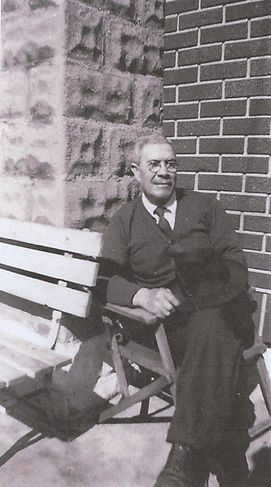
Francesco in Bayside
